Biocompatible design
Highly purified atelocollagen minimizes immune response

Is intended to reinforce soft tissue
where weakness and deficiencies exist.
 Download US Instructions for UseDownload International Instructions for Use
Lymphedema is persistent swelling that develops when fluid drainage is impaired due to damage to the lymphatic vessels or lymph nodes.
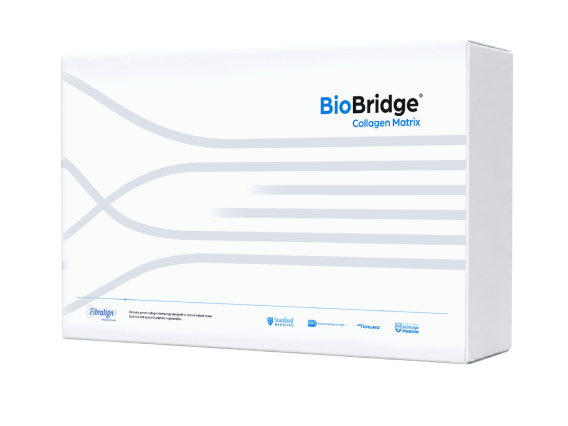
BioBridge is manufactured from highly purified Type I porcine-derived collagen sourced from an FDA-registered and ISO-qualified supplier. Using Fibralign’s patented Nanoweave® technology, a proprietary manufacturing process produces collagen membranes with highly aligned fibrillar architecture, mimicking the mechanical properties of native extracellular matrix.
Biocompatible designHighly purified atelocollagen minimizes immune response
Tissue integrationDesigned to integrate into soft tissue safely and fully resorb
Ready to useProvided in single-use sterile packaging
Evidence-basedPreclinical and clinical evidence validates tissue repair potential


BioBridge is a ready-to-use scaffold supplied in sterile single-use “5-packs” with each device stored in its own delivery tube
Find a Distributor